
Blog post Title 3
Mar 13, 2018
Lorem ipsum dolor sit amet, consectetur adipiscing elit. Etiam suscipit, purus in dignissim aliquam, nulla nibh pellentesque metus, ut accumsan urna lectus id metus. Vestibulum eget ligula porta urna facilisis placerat. Phasellus ornare non metus eget blandit. Ut et elementum eros. Duis ut ligula porttitor, venenatis metus nec, ultrices ante. Aliquam blandit purus eget purus elementum, at ultrices sem pharetra. Ut sodales mauris nec maximus mattis. Nunc eleifend mauris lorem, in interdum ex volutpat vitae. Mauris vitae justo dignissim sem aliquet imperdiet. Mauris euismod lorem vel nibh posuere fermentum. Aliquam non efficitur elit. Fusce in blandit ex. Sed ultrices faucibus turpis. Vestibulum at tellus et metus suscipit auctor. Aenean vitae nisl sem.
Nunc volutpat dui et congue interdum. Suspendisse ex orci, luctus nec egestas eget, egestas vel neque. Morbi feugiat mollis metus, eget imperdiet ex venenatis id. Vestibulum vel dolor mauris. Fusce mattis at ipsum vitae lacinia. Vivamus sit amet rhoncus quam. Donec eu auctor tellus. Ut ut ornare urna. Sed erat nulla, vulputate et maximus eu, condimentum sit amet leo. Nullam odio lorem, sagittis finibus orci ac, faucibus tincidunt elit.
Cras ornare posuere ipsum, id porta lectus imperdiet nec. Sed felis massa, volutpat eget lectus et, interdum blandit mi. Nunc sit amet maximus mauris. Quisque aliquet ut lacus ornare congue. Proin eget hendrerit nibh. Vivamus quis turpis cursus, pellentesque urna vitae, vulputate tortor. Nam nec mauris mattis, malesuada odio quis, hendrerit sem.

Blog post Title 2
Mar 13, 2018
Lorem ipsum dolor sit amet, consectetur adipiscing elit. Etiam suscipit, purus in dignissim aliquam, nulla nibh pellentesque metus, ut accumsan urna lectus id metus. Vestibulum eget ligula porta urna facilisis placerat. Phasellus ornare non metus eget blandit. Ut et elementum eros. Duis ut ligula porttitor, venenatis metus nec, ultrices ante. Aliquam blandit purus eget purus elementum, at ultrices sem pharetra. Ut sodales mauris nec maximus mattis. Nunc eleifend mauris lorem, in interdum ex volutpat vitae. Mauris vitae justo dignissim sem aliquet imperdiet. Mauris euismod lorem vel nibh posuere fermentum. Aliquam non efficitur elit. Fusce in blandit ex. Sed ultrices faucibus turpis. Vestibulum at tellus et metus suscipit auctor. Aenean vitae nisl sem.
Nunc volutpat dui et congue interdum. Suspendisse ex orci, luctus nec egestas eget, egestas vel neque. Morbi feugiat mollis metus, eget imperdiet ex venenatis id. Vestibulum vel dolor mauris. Fusce mattis at ipsum vitae lacinia. Vivamus sit amet rhoncus quam. Donec eu auctor tellus. Ut ut ornare urna. Sed erat nulla, vulputate et maximus eu, condimentum sit amet leo. Nullam odio lorem, sagittis finibus orci ac, faucibus tincidunt elit.
Cras ornare posuere ipsum, id porta lectus imperdiet nec. Sed felis massa, volutpat eget lectus et, interdum blandit mi. Nunc sit amet maximus mauris. Quisque aliquet ut lacus ornare congue. Proin eget hendrerit nibh. Vivamus quis turpis cursus, pellentesque urna vitae, vulputate tortor. Nam nec mauris mattis, malesuada odio quis, hendrerit sem.

Blog post Title 1
Mar 13, 2018
Lorem ipsum dolor sit amet, consectetur adipiscing elit. Etiam suscipit, purus in dignissim aliquam, nulla nibh pellentesque metus, ut accumsan urna lectus id metus. Vestibulum eget ligula porta urna facilisis placerat. Phasellus ornare non metus eget blandit. Ut et elementum eros. Duis ut ligula porttitor, venenatis metus nec, ultrices ante. Aliquam blandit purus eget purus elementum, at ultrices sem pharetra. Ut sodales mauris nec maximus mattis. Nunc eleifend mauris lorem, in interdum ex volutpat vitae. Mauris vitae justo dignissim sem aliquet imperdiet. Mauris euismod lorem vel nibh posuere fermentum. Aliquam non efficitur elit. Fusce in blandit ex. Sed ultrices faucibus turpis. Vestibulum at tellus et metus suscipit auctor. Aenean vitae nisl sem.
Nunc volutpat dui et congue interdum. Suspendisse ex orci, luctus nec egestas eget, egestas vel neque. Morbi feugiat mollis metus, eget imperdiet ex venenatis id. Vestibulum vel dolor mauris. Fusce mattis at ipsum vitae lacinia. Vivamus sit amet rhoncus quam. Donec eu auctor tellus. Ut ut ornare urna. Sed erat nulla, vulputate et maximus eu, condimentum sit amet leo. Nullam odio lorem, sagittis finibus orci ac, faucibus tincidunt elit.
Cras ornare posuere ipsum, id porta lectus imperdiet nec. Sed felis massa, volutpat eget lectus et, interdum blandit mi. Nunc sit amet maximus mauris. Quisque aliquet ut lacus ornare congue. Proin eget hendrerit nibh. Vivamus quis turpis cursus, pellentesque urna vitae, vulputate tortor. Nam nec mauris mattis, malesuada odio quis, hendrerit sem.
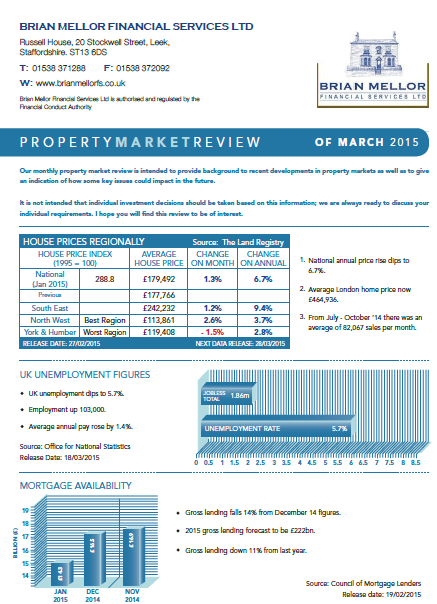
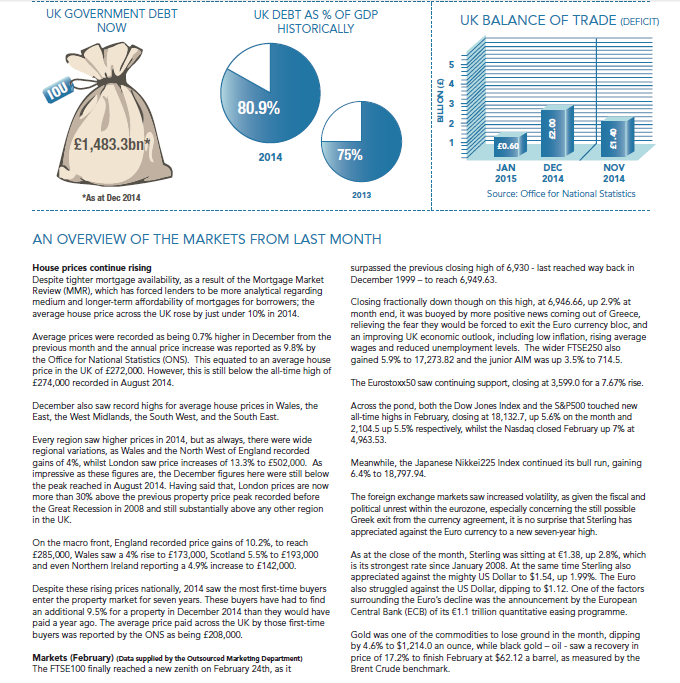
Property Market Reveiw March 2015
Mar 24, 2015
Pension Flexibility 2015
Mar 5, 2015
.jpg)
Will it really be possible to take unlimited income from any defined contribution scheme after 6 April 2015?
From 6 April 2015, retirement income limits will be removed for defined contribution (DC) pensions. So members of pension age will be able to take what they want from their DC pension pot, when they want it. And, unlike the current rules for flexible drawdown, there won't be a ‘minimum income requirement'.
There will be two main bases for accessing DC funds flexibly:
- Flexi-access drawdown - income drawdown will be known as flexi-access drawdown. You'll be able to draw any amount, over whatever period you chose.
Generally speaking, you'll be able to take 25% of the fund as a tax free lump sum when you designate new funds for drawdown and any income drawn is then taxable as pension income.
As soon as you access any fund under flexi-access drawdown, you'll normally be subject to a reduced annual allowance for DC contributions. However, existing ‘capped drawdown' users on 5 April 2015 won't be caught - as long as their drawdown income remains within the income cap.
Existing ‘flexible drawdown' funds will automatically convert to flexi-access drawdown on 6 April 2015 - good news, as currently those in flexible drawdown have zero annual allowance. - Uncrystallised funds pension lump sums - you'll be able to take a single or series of lump sums from your uncrystallised funds, without actually having to designate them for drawdown first.
25% of the amount paid is tax free, with the balance taxable as pension income.
But there are conditions that must be met:- It must be payable from uncrystallised rights held under a money purchase arrangement;
- If under age 75, you must have more lifetime allowance remaining than the amount of the lump sum you want to take;
- If age 75 or over, you must have at least some lifetime allowance remaining when you want to take the lump sum; and
- You must be at least age 55 or meet the ill-health conditions.
Additionally, you can't take such a lump sum if you have:
- primary or enhanced protection with protected tax free cash rights; or;
- a lifetime allowance enhancement factor, but your lump sum allowance is less than 25% (such as from receiving a pension credit on divorce from a pension already in payment).
Anyone with scheme specific lump sum protection, allowing tax free cash of more than 25% of the fund, can't take an uncrystallised funds pension lump sum from that scheme - unless they give up their right to the higher tax free cash.
Again, taking such a lump sum will invoke the reduced DC annual allowance.
The key, of course, will be using this new flexibility sensibly to meet financial needs tax-efficiently. The new freedom brings temptation and a lot of new responsibility and there's a danger that some pension savers will draw their pension savings at the first opportunity. This could see them hit with a large income tax bill - much larger than the bill for only taking what they needed, when they needed it.
And, of course, there's a danger that some may fritter it all away without any constraints to hold them back. Equally, there will be those who will be tempted to stick it all in the bank - but they do so at their peril as the long term effects of inflation may erode their fund's spending power.
There are some circumstances where the new flexibility is not available:
- Existing annuities or scheme pensions: Those who have locked into a lifetime income using annuities, or scheme pensions, can't undo them. This means many existing pensioners won't have access to the new flexible income options.
- Defined benefit pensions: The new income flexibility may not be available for defined benefit pensions - the Government plans to consult on whether to allow this. However, those with AVC pots will be able to access flexibility, either within the DB scheme or by transfer to a new pension.
- Scheme/product restrictions: Although a statutory override will allow schemes to ignore their rules and follow the tax rules instead, there's no obligation for every DC pension scheme or provider to offer the new income flexibility. For example, some pension schemes may not have systems in place to facilitate DC flexibility.
So it may be necessary to transfer benefits to a pension scheme that is able to facilitate this. Clients will have a right to transfer to a new scheme or provider to access DC flexibility where their current scheme doesn't offer it. In particular, existing restrictions will be lifted so that members of occupational schemes will now be able to transfer at any point up to their scheme's normal pension age. However, it won't be possible to transfer DB rights from unfunded public service schemes to access DC flexibility.
What is the ‘guidance guarantee’ that pension members will have from 6 April 2015?
Pension scheme members will have access to free, impartial guidance on their pension income choices.
The Citizens Advice Bureau will provide face to face guidance and the Pensions Advisory Service will provide phone-based guidance. An online service will also be developed.
The guidance won't be FCA-regulated, but the FCA will set standards for guidance providers and monitor compliance with those standards.
Schemes and providers will have a new duty to make ‘at retirement' clients aware of this guidance option and give them sufficient information about their pension pot to help them make sense of the guidance.
The guidance isn't intended to replace professional advice: indeed, it should act as a gateway to advice for those who need it.
It's proposed that the new guidance guarantee will be funded by a levy on regulated firms.
Will those who access the new pension flexibility from 6 April 2015 be able to continue making pension contributions?
Yes, however, the Government had to react to the possibility of over 55s using the new flexibility for immediate risk-free gain. They've addressed this by introducing an anti-avoidance control, which it estimates will only affect 2% of pension savers over 55.
Once someone has accessed the new flexibility, their pension annual allowance for DC contributions will drop to £10,000. So they'll still have an annual allowance of £40,000, but no more than £10,000 can be paid to DC schemes.
The trigger for the drop in DC annual allowance will be when the individual, after 5 April 2015, first takes:
- an uncrystallised funds pension lump sum;
- income from a flexi-access drawdown fund (including payments from a short-term annuity provided from a flex-access drawdown fund);
- a flexible annuity;
- income of more than the income cap from a fund that was in capped drawdown pre-6 April 2015;
- a stand-alone lump sum from a DC arrangement, but only if relying on primary protection and where lump sum rights have also been registered for primary protection;
- a scheme pension from a DC arrangement that's providing scheme pensions to less than 12 members (including dependants) at the time the first payment is made; or
- notifies their scheme administrator that they want to convert their pre-6 April 2015 drawdown fund to a flexi-access drawdown fund, then takes income from that fund.
Existing flexible drawdown funds will automatically convert to flexi-access drawdown on 6 April 2015, allowing individuals with such funds to restart pension funding, within the new annual allowance limits.
Exemptions from the reduced DC annual allowance
The following won't result in the £10,000 allowance for DC schemes:
- Tax free cash only: Only taking a tax free lump sum won't trigger the allowance cut - even if the remaining pot is designated for flexible income/drawdown. It's actually taking flexible income that counts.
- Secure income: Taking a secure income, such as a non-flexible annuity or defined benefit pension, won't trigger the allowance cut.
- Capped drawdown: Existing capped drawdown users on 5 April 2015 won't be caught - as long as their drawdown income remains within the income cap.
Also, designating new funds for drawdown within a capped drawdown plan which is a single arrangement will keep the £40,000 limit - providing, of course, the income remains within the capped drawdown limit. - Small pots: Small pots taken as lump sums under the triviality or stranded pots rules won't trigger the allowance cut.
- Dependants' pensions: The payment of dependant's flexi-access drawdown won't trigger the allowance cut. But it will be triggered if the dependant receives an uncrystallised funds pension lump sum or flexi-access drawdown from their own funds.
Information requirements
Scheme administrators will have to provide a statement to the member within 31 days when they first flexibly access their pension. The member will then have to notify any other schemes that they're a member of within 31 days of receiving their statement, so that they're also aware that the £10,000 DC allowance will apply.
If an individual joins a new scheme, they will have to tell the scheme administrator within 31 days if they have previously flexibly accessed benefits - unless the new scheme has been established by a transfer. In this situation, it's the duty of the scheme administrator of the transferring scheme to tell the receiving scheme administrator within 31 days of the date of transfer.
What changes are being made to pension death benefits from 6 April 2015?
An individual's age at death will still determine how their pension death benefits are treated. The age 75 threshold remains, but with some very welcome amendments.
- Death before 75 - defined contribution pension funds can be taken tax free, at any time, whether in instalments, or as a one-off lump sum. This will apply to both crystallised and uncrystallised funds, which means those in drawdown will see the potential tax charge on death cut from 55% to zero overnight.
Survivors' pensions will no longer be restricted to dependants. So non-dependent beneficiaries will also have an alternative to the lump sum death benefit. Using the fund to provide beneficiaries with a sustainable stream of income allows the fund to potentially grow tax free, while remaining outside their estate for IHT. - Death after 75 - defined contribution pension funds can be taken in instalments and will be taxed at the beneficiary's marginal rate as they draw income from it. Alternatively, they'll be able to take it as a lump sum less a 45% tax charge (this will become their marginal rate from 2016/17).
We understand these new rules will apply to payments made on or after 6 April 2015 rather than the date of death. So where payment of death benefits can be delayed until after 5 April 2015, the beneficiaries will be able to take advantage of the new rules.
The changes can be summarised as follows:
Death pre 75
Old rules | New rules | |
Lump sum | • Uncrystallised funds - tax free. | • All tax free. |
Income | • Option only available to dependants. | • Tax free if taken via new flexible income. |
Death post 75
Old rules | New rules | |
Lump sum | • Subject to 55% tax. | • Subject to 45% tax |
Income | • Option only available to dependants. | • Option available to any beneficiary . |
The death benefit position differs for annuities and defined benefit schemes:
- Annuities - The changes will also apply to lump sums from value protected annuities, with payments made tax free if death is before age 75 and taxed at 45% (marginal rate from 2016/17) after this age. However, survivors' annuities will continue to be taxed at the survivor's marginal rate, regardless of the date the member died.
- Defined benefits - A similar position applies to death benefits from defined benefit schemes. Again, if the scheme allows lump sum death benefits to be paid from pensions in payment, these will be tax free on death before 75 or taxed at 45% (marginal from 2016/17) on death from age 75. Any continuing dependant's pension will still be taxed at their marginal rate.
This leaves dependants' pensions from annuities and defined benefit schemes at a disadvantage to someone who's receiving income from a beneficiary's drawdown. If the original scheme member died before age 75, the drawdown beneficiary will receive tax free income, compared to income taxed at their marginal rate from an annuity or scheme pension.
And, of course, the lifetime allowance may still have an impact on the above.
Will defined benefit to defined contribution pension transfers be allowed from 6 April 2015?
Pre-retirement members of funded defined benefit (DB) pension schemes will be allowed to transfer to defined contribution (DC) to access the new income flexibility if they want to - but only if they've taken advice from an independent FCA-regulated professional first*.
Most DB members are likely to be best served by sticking with what they've got. But there will be members whose needs will be better met by moving to the new flexibility - particularly wealthier savers who value tax-planning flexibility and wealth transfer options over a guaranteed income.
The existing ban on transfers once benefits are in payment will continue. And members of unfunded public sector DB schemes won't be able to transfer to DC schemes.
* There will be an exemption from the advice requirement for those with rights worth less than £30,000.
Will there still be a place for lifetime annuities from April 2015
The security of lifetime annuities means that they'll still be the right income solution for many clients. But, of course, the changes coming in 2015 will likely mean that they won't be as widely suitable in future.
In line with its commitment to deliver a more flexible pensions regime, the Government will remove some restrictions around annuities to enable providers to develop more flexible products. The changes will:
- Allow lifetime annuities to decrease. This could, for example, allow a reduction when the pensioner reaches State Pension age.
- Remove the 10 year maximum guarantee period.
A surprise in the draft regulations is that there will no longer be a requirement for the member to be given the opportunity to select the insurance company that the annuity is bought from - known as the open market option. Schemes can, however, still offer this if they want to.
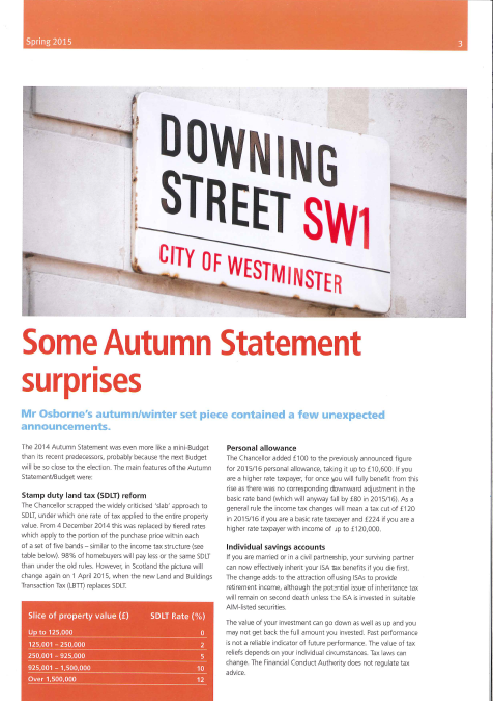
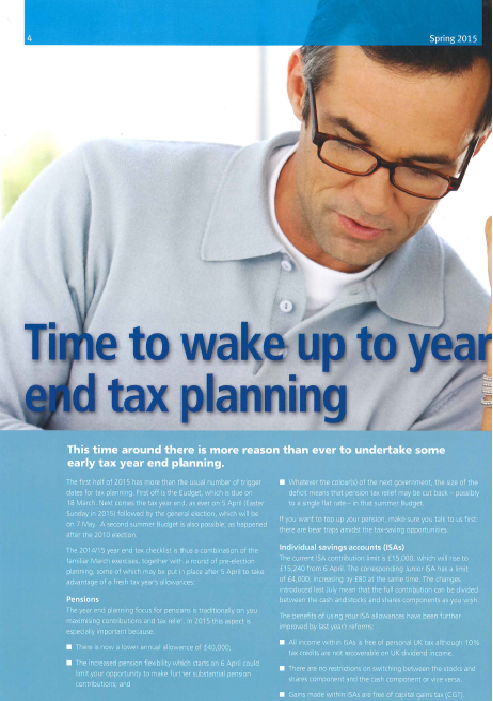
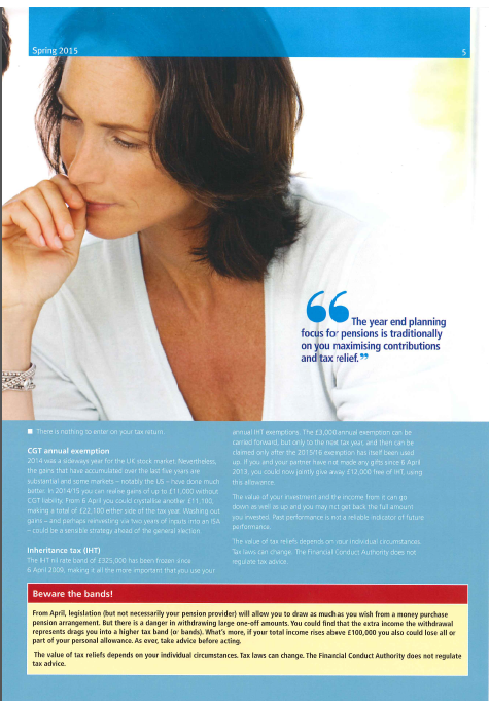
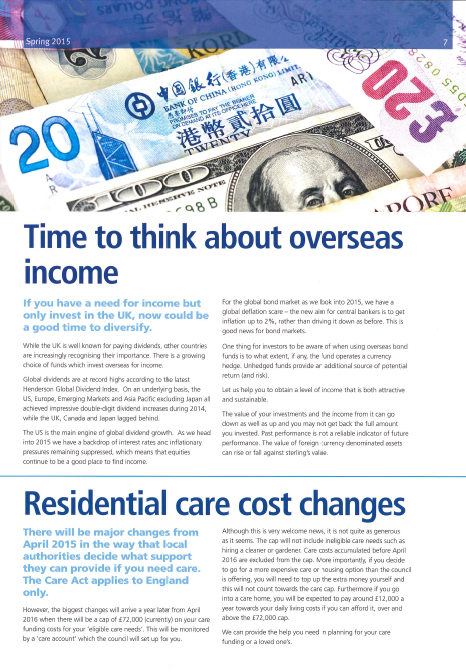
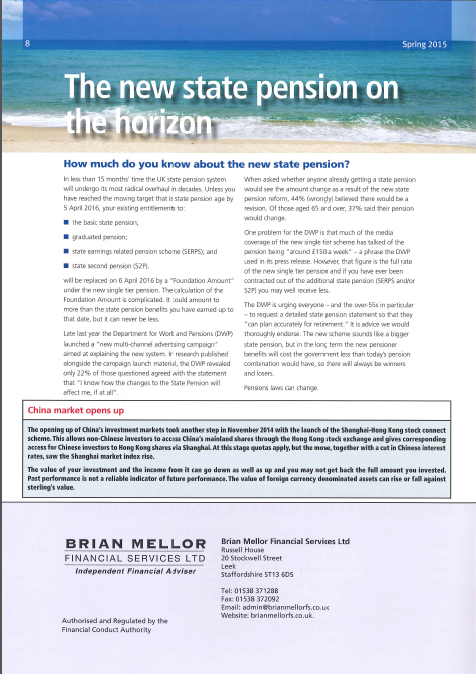
Spring Newsletter 2015
Feb 25, 2015


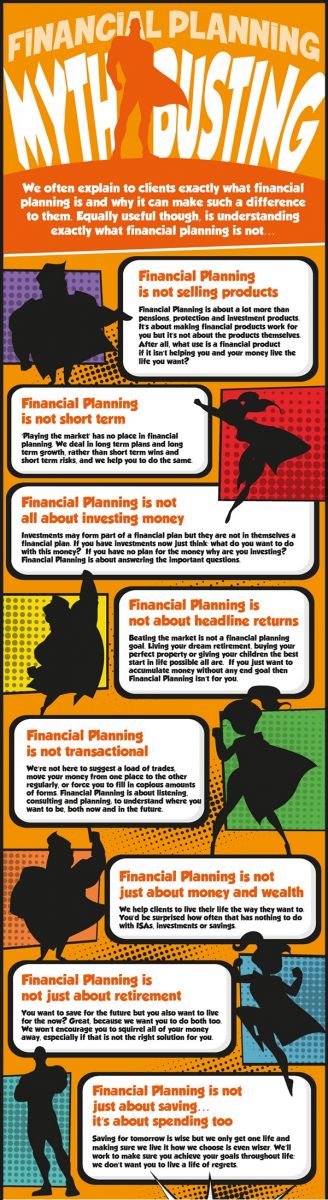
Financial Planning, MYTH-BUSTING!
Feb 2, 2015
Property Market Reveiw January 2015
Jan 23, 2015
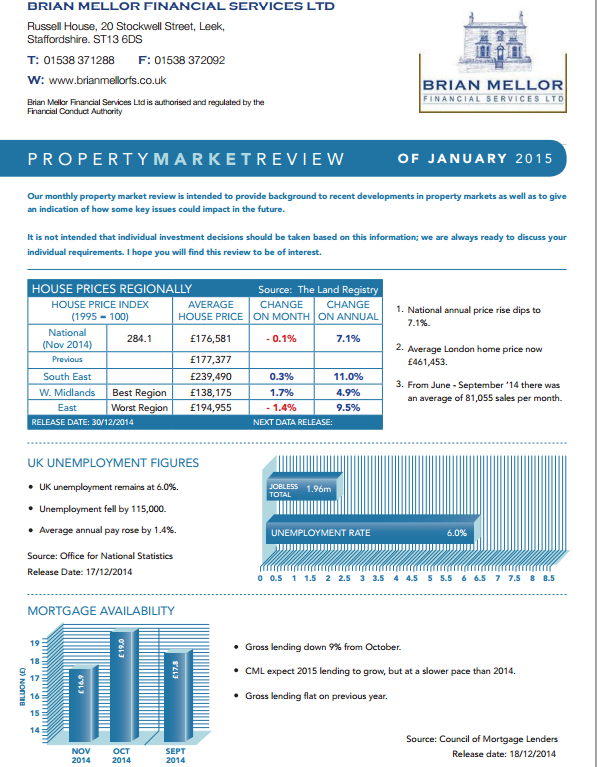
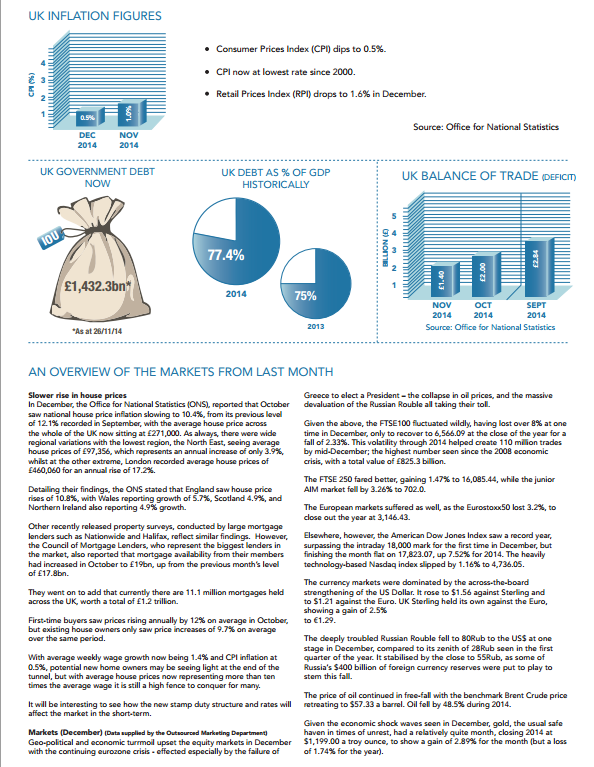
Here's Our Economic Review of December 2014
Jan 6, 2015
.png)
(1).png)
INTEREST RATE RISES BACK ON HOLD
Dec 11, 2014
~~The bank of England’s latest Quarterly Inflation Report (QIR) suggests an interest rate rise will not now occur until well after the General Election.
The Governor of the Bank of England, Mark Carney, has been described as “an unreliable boyfriend” for the way in which he has so frequently appeared to change his view on the timing of the first interest rate rise. Back in June he told a Mansion House audience that the first rise could happen “sooner than expected”, which the markets read as being November 2014. However, when that month came, Mr Carney’s introductory remarks at the Quarterly Inflation Report (QIR) press conference were taken as meaning no rate rise until October 2015 or possibly later.
There were two main reasons why Mr Carney was (once again) pushing out the rate rise date:
1. The Bank had adopted a slightly gloomier view of the global economic outlook, which meant it had nudged down its UK growth forecasts. All other things being equal, slower growth means less pressure for higher interest rates.
2. Inflation had fallen faster than expected and was now thought “likely to remain close to 1% over the next year”. The outlook for inflation was such that Mr Carney said “it is more likely than not that I will have to write an open letter to the Chancellor in the next six months on account of the inflation rate falling below 1%”. All the previous letters (from Mr Carney’s predecessor) have been explaining why inflation was more than 1% above target.
Ironically, we seem to be almost coming full circle to when Mr Carney was new to the job and gave his first piece of “forward guidance”: an interest rate review would be triggered when the unemployment rate fell below 7%, which the Bank thought would be in the third quarter of 2016. Unemployment is now 6%, but is not yet creating any inflationary pressure, witness the very low level of pay increases.
The knock on result is that for now savings rates seem set to remain at today’s miniscule levels for close to another year.
The value of investments can go down as well as up and you may not get back the full amount you invested. Past performance is not a reliable indicator of future performance.